Roger Gough
Showing posts with label KCC. Show all posts

Saturday, 3 May 2025

Over and Out

It’s pretty old news now, but worth summarising yesterday’s Kent County Council election results. The pace of events yesterday left no time to post.

So, firstly, the executive summary: the Conservatives are out, and I’m out. 

Here is the result for Sevenoaks North and Darent Valley:


Marc Logen (Reform UK)                  2,133 (37%)

Roger Gough (Conservative)            1,945 (33%)

Adam Durbaba (Liberal Democrat)  1,103 (19%)

Michael Barker (Green Party)              387 (7%)

Ben Davies (Labour)                             283 (5%)


My warm congratulations to Marc Logen on his election. We had a good conversation at yesterday’s count and I wish him very well. He has, as I have had for 20 years, the great good fortune to represent a truly wonderful part of Kent.

The result is a huge reversal from 2021, and from previous elections. Yet it was just part of a wider rout for the Conservatives across Kent, and the country. (The elections were also very poor for Labour, but they had many fewer seats to defend). At KCC, the Conservatives now have just 5 seats out of 81 (we won 62 in 2021). Reform UK took 57 seats and will form the new administration; the Liberal Democrats, with 12 seats, will be the opposition. Across the country, we lost 676 of the 993 council seats that we were defending.

I have given a lot of interviews since the results were announced, including one for the Today Programme this morning (there is a clip at around 8:33). My view is that the Conservatives are still paying the price for aspects of our record in government, especially in 2021-22, and have to fight hard for a right to be heard, even as any goodwill towards the Labour government is rapidly dissipated. 

I also wish the new Reform administration well as they take over at County Hall. Too much - for the council and for the county - rides on their success for anyone to wish otherwise. I did not, though, see anything in the campaign to suggest serious engagement on their part with the big challenges and pressures that face the council (such as adult social care, children’s services and SEND). It is up to them to surprise us.

Wednesday, 30 April 2025

Vote Conservative on Thursday 1 May

Vote for your local Conservative candidate in tomorrow (Thursday’s) election to Kent County Council. There’s a lot at stake. 


FACT: Across the country, councils are failing or on the financial brink. Eight have gone bust (‘a Section 114 notice’). Thirty are on life support from central government. Conservative Kent County Council is not among them

FACT: We deliver sound budgets, even under intense pressure, and our financial management is strong (it’s not us saying that, it’s our external auditors). We have saved approaching £1 billion over the last decade, cut debt costs from 13% of our budget to 8% and brought many areas of big spending pressure under control. We are making our services secure for the future

FACT: We stand up for Kent. We have made sure that Kent council tax payers are not on the hook for the costs of asylum. We took the government to the High Court – and won – so that unaccompanied minors are moved rapidly to other parts of the country 

FACT: We are there when you need us. We have helped residents through tough financial times, including pensioners targeted by Labour’s withdrawal of the Winter Fuel Payment. We provide some of the best and lowest-cost services to protect vulnerable children in the country


Money will stay tight, and we can’t expect help from a cash-strapped Labour government. Local government reorganisation, driven by Labour, means there’s a huge job in safely transferring our vital services – for some people, a matter of life and death - to new councils.

These challenges need serious, dedicated councillors who care about our communities, not those who offer only slogans and treat them as a vehicle for protest about national politics.

For a council that cares about Kent and our communities; that will keep Kent financially secure; and that will always stand up for Kent – vote Conservative on Thursday 1 May.

Wednesday, 19 March 2025

Tackling drainage in Watery Lane


Watery Lane will be closed overnight from tomorrow night (20 March) for up to two nights. The closure will be between 8PM and 5AM, and the closure will be from Chaucer Business Park to the junction of Saxbys Road. This is for KCC to undertake drainage works to address the long-standing problems on the road. 

While there are a number of factors affecting Watery Lane, in particular the interaction between the Network Rail drainage system under the bridge and the Kent Highways drainage system, the works to be undertaken over the next couple of days will focus on the latter. There will be a thorough cleanse of all the gullies, catchpits and manholes and jet all the pipework in the Kent Highways system in that section of the road.

Once these works have been completed, and it is confirmed that they have been effective (our drainage engineer will review the works on completion) the Highways Operations team will be able to carry out the necessary repairs to the road surface; they have been unable to do so as long as the water is running.

Hopefully these works will provide some relief from the problems that have affected this section of road. I will post again when there are further updates on how the works have gone and when the road surface repairs can take place.

Monday, 17 March 2025

Pilgrims Way closures

A quick note on today’s significant disruption on Pilgrims Way and Pilgrims Way East. 

The Pilgrims Way closure (between junctions with The Landway and Old Terrys Lodge Road) was for urgent highway works by KCC - patching that needed to be undertaken rapidly. These works are set to go on through to the end of the week.

When these works were under way, BT Openreach closed PWE between Tudor Drive and Row Dow under emergency closure provisions (I’ll come back to the merits or otherwise of that shortly). As is usual in these cases, KCC was not notified until after the road was closed.

My thanks to Simon Reay for highlighting that there were severe problems/ deficiencies with the signage and access for residents on the KCC Pilgrims Way works. I took this up with the Streetworks team and got the following information/ action.

The surface for the patching work in Pilgrims Way will reinstated tomorrow and Wednesday, and from Wednesday the section between The Landway and Cotmans Ash Lane should be reopened. Between Cotmans Ash Lane and Old Terrys Lodge Road will remain closed until Friday. Residents should already have access to their homes, although there may be delays while specific sections of the road are made safe for that access. The Streetworks Inspector will attend the site tomorrow morning to make sure the right signage is in place.

This should not have been as disruptive as it was, and I am sorry for the bad experiences residents had today; hopefully these steps will make the situation a lot more manageable for the remainder of the works. 

In relation to PWE and the BT works, Openreach confirmed at 1:15 that they were complete and the road was being reopened. What this does highlight, though, is the use made of emergency provisions. KCC (and other highway authorities) has been raising this issue for some time. A change in national policy is required. Fortunately, the House of Commons Transport Select Committee is carrying out an inquiry into the issue because it is a major problem across the country. KCC put in a very strong submission to the Inquiry and so we have been invited to give evidence this week.

Finally, all this is separate from the highways improvement works on Pilgrims Way East next week (24-25 March), which as anyone who has driven through there will know, has been notified for some time.

Wednesday, 19 February 2025

Park Lane works completed

The works and road closure in Park Lane Seal have been completed well ahead of schedule. 

The contractor had completed the works by late on Monday (the first day) and so the road was already open throughout yesterday - which is why there seemed to be no evidence of the closure by late afternoon. 

The original closure was scheduled for up to five days. Given the difficulty of alternative routes when Park Lane is closed, it is good that the contractor was able to allocate extra resource to the works and so minimise the disruption to residents and to the wider road network.

Sunday, 16 February 2025

Better Children’s Services: the Education Select Committee


This is going back a few days (it’s been a busy week); on Tuesday I gave evidence to the House of Commons Education Select Committee on aspects of the government’s Children’s Wellbeing and Schools Bill. I was there in my role as Children’s Services spokesperson for the County Councils Network (CCN), although I also made reference to experiences in Kent, and was alongside representatives from the Competition and Markets Authority (CMA), the National Network for the Education of Care Leavers and the charity Kinship.

This was to some degree a repeat of the evidence that I gave to the same Committee (albeit with entirely different membership) in March last year. As before, this covered the problems of cost and service availability in children’s services. This was the subject of the well-regarded Independent Review of Children’s Social Care, chaired by Josh MacAlister (now a Labour MP), followed by a White Paper and a number of initiatives under the previous government. The difference this time is that there is now legislation under consideration, and that the evidence session focused on the Bill’s provisions in relation to management of the market, the development of Regional Care Cooperatives, kinship care, the expanding role of Virtual Schools and care leavers.

While I am critical of some of the education provisions of the Bill (some of which the government has had to row back on), the approach to children’s services is sensible and a welcome example of continuity between governments and across parties. In particular, the problems in the provision of children’s social care (highlighted in a report by the CMA some years ago) are best addressed through strengthening local authority commissioning and increasing the supply of places, as argued in a report (The Way We Care) commissioned by CCN last year. The bill gives the Secretary of State powers to introduce a profit cap, but it is very much a reserve power if other measures fail. That is a right and pragmatic approach; a cap now, without the introduction of other measures, could simply reduce the available provision.

At the end of the session, I highlighted “the elephant in the room”: the £2.5 billion in funding that Josh MacAlister highlighted as necessary to deliver the reforms that the Independent Review advocated. The previous government’s White Paper, Stable Homes, Built on Love was well-received but did not commit to this funding. In the autumn budget and subsequent local government financial settlement, the government established a £270 million Children’s Social Care Prevention Grant. I urged that this should be viewed as a down payment on the funding needed to deliver a comprehensive programme of reform.

You can find the evidence session on the parliamentary TV channel here.

Friday, 14 February 2025

Park Lane Seal closure from Monday

The emergency closure of Park Lane Seal next week was announced yesterday. The closure, between the junctions with Blackhall Lane and Bichet Green Road, will start on Monday for up to five days (17-21 February). This is for essential safety works to trees on unregistered land that Kent Highways is undertaking under its statutory duty of care. Because of the width of the carriageway and the height of the trees the road has to be closed in full rather than a single lane.

The closure is permitted between 8am and 5pm for each day but may on occasion be shorter. The road will reopen when the contractors leave the site each evening. In addition, while the work is scheduled for five days, it is hoped to be less; significant contingency for bad weather, break downs and other delays is built in. 

Any closure on a road like Park Lane will be disruptive, but hopefully scheduling this in half term and delivering the works promptly will minimise this.

KCC budget: Fit for tough times


At Kent County Council yesterday we passed the budget for 2025-26. 

The circumstances in which we have set the budget remain difficult. Over the last few years, pressures in adult social care, children’s services and Special Educational Needs (in particular, in relation to transport) have outpaced the growth in our resources.

While we have made a lot of progress in the first two areas in the last eighteen months (SEN transport is now coming in under budget in the later stages of 2024-25), savings in adult social care are proving harder to realise, and our expenditure outside adults’ and children’s services is still set to fall in 2025-26. This is in spite of an increase in council tax of just under 5% (the referendum limit, although unlike some other councils we did not attempt to go beyond that). 

In my remarks to the council I pointed out that, with public spending under pressure, the government leaning towards methods of distributing funding that do not work in Kent’s favour and many major areas of spending unlikely to be reformed in the near future, the situation will remain tough for the foreseeable future. “There is no cavalry coming over the hill. There is only the hill. So, we have to have a budget fit for that stretching environment, setting us up for a number of years, which is what this budget does.” We share these pressures with councils up and down the country.

The budget continues our savings and transformation programmes in core services, delivers the first part of a nearly £20 million savings package in discretionary expenditure and rebuilds our general reserves in recognition of that tough operating environment. Amendments put forward by opposition groups covered just 0.4% of the budget spend, and none were agreed by County Council.

You can find our media release here.


Wednesday, 5 February 2025

Devolution - but NOT for Kent and Medway

The government announced today that a number of areas have been taken forward for the Devolution Priority Programme (DPP) set out in the English Devolution White Paper. Although all of our neighbours who applied - Greater Essex, Sussex & Brighton, Hampshire & Solent, Surrey (in the latter case, a slightly different application) - were accepted on to the programme, Kent and Medway were not.

As I have set out in a number of interviews today, this is a severe setback, leaving Kent as a devolution desert when all our neighbours will benefit from the increased powers, funding and national voice that will be denied to the 1.9 million residents of Kent and Medway. 

It is also an incomprehensible decision with no clear and logical rationale. We are told that it is because Kent and Medway are local authorities of very different size who could not operate together effectively in a mayoral authority. This argument was never made to us before and flies in the face of disparities of size of authorities in areas which have been approved - and existing models elsewhere, such as North Yorkshire and the City of York. 

We will continue to press for a fuller explanation of this decision, and to get the benefits of devolution to the residents we represent as soon as possible.

You can find our media release, and my reaction here.


Thursday, 30 January 2025

Potholes in Old Chapel Road

Many thanks to Rachel Waterton for raising the issue of the potholes on Old Chapel Road, scene of yesterday’s accident. I have taken this up with Kent Highways officers. A job was raised yesterday morning for a 7 day repair, but in addition one of the highways officers will revisit today to make sure they are safe in the interim.

Wednesday, 15 January 2025

Devolution: What we are doing and Why

As mentioned in my previous post, here’s what I set out to the County Council in last Thursday’s debate on the proposal for us to join the Devolution Priority Programme. You can find the full webcast of the debate on KCC’s website.

KCC has also set up a devolution webpage, with some explanations, links to documents and a video that I have recorded about devolution.


This is the most momentous decision for this Council in many, many years. It is a decision for Cabinet, and Cabinet will meet later today to take it. But for a decision of this kind, it is right that County Council considers it in full and that all Members are engaged.

We have got here through a strong partnership, on a cross-party basis, with our colleagues in Medway and an inclusive approach to working with District and Borough Councils that is matched in few if any parts of the country.

The question before us is whether or not we, along with Medway Council, apply to join the Devolution Priority Programme, resulting in the creation of a Mayoral Combined Authority and a mayoral election in May 2026. Everything else flows from that choice.

I believe we should.

That is because:

Devolution is coming. The only question is how far we shape it, or let others shape it for us.

It is, or soon will be, a reality across the country. Others are moving fast.

And there are great opportunities for us, and for the residents we represent, in devolution. We need to seize them.

 Mayoral devolution is a very settled government policy. It was the policy of the last administration. Within a fortnight of the new government being formed, a letter from the Deputy Prime Minister to local government leaders made clear that this was their policy too, and in a more comprehensive and systematic way.

At the LGA conference, the minister, Jim McMahon, made it utterly clear that this was a structured policy for England as a whole – with no orphan areas. 

And in local government reorganisation, which came up fast on the rails in the weeks before the publication of the White Paper, all remaining two-tier areas are expected to submit initial unitary proposals by March. Whether you are in the Devolution Priority Programme or not, that issue is going to be on the table.

I think we know that change is coming. And who here, in their heart of hearts, believes – really believes - that in three, four, five years’ time we will be carrying on just as we are?

 So the sooner we engage with this, the more scope we have to shape it. The sooner we engage, the sooner we can give the clarity that we owe to our residents, our staff and our organisations.

 We also need to look beyond our own boundaries. Over the last decade, and steadily gathering pace, mayoral authorities have become part of the national landscape.

Look at a map, and draw a line from the Mersey to the Wash: almost everything north of that, with Cumbria the main exception, either has or is on track for a mayoral authority.

And now we know that across the south, and among our neighbours, letters are going in to apply to the Devolution Priority Programme. That map is likely to look much more complete, and pretty soon. Every one of those areas with access to the powers, the funding and the national voice that Kent would be missing out on.

And above all, we should enter the Devolution Priority Programme because of those benefits – why should we not secure them for the nearly 2 million residents of Kent and Medway as quickly as possible?

 And if we do take that step, the final part of the recommendation today notes the implications of joining the Devolution Priority Programme for the County Council elections.

This is not something that we initiated

It is not something that we will decide

It is not something that I relish

In his letter of 16 December, the minister stated that, to deliver both devolution and reorganisation according to the exacting schedules of the Devolution Priority Programme, he was minded to lay secondary legislation to postpone local elections from May 2025 to May 2026.

That decision will be made by ministers, but they require a request from councils for this to be considered.

I recognise that this goes against the grain for all of us whose role here rests on our democratic electoral mandates. But across the country there are many precedents for postponement when you have profound structural change – we saw several at the time of the 2021 elections – and we must be clear that this is not an indefinite extension of County Councillors’ terms, running for up to three years beyond our mandate. That would be neither acceptable nor feasible, and there are different options under which we stick to a much more tightly limited deferral.

It is clear that there is a very tight link indeed between participation in the DPP and the decision that the minister is minded to take. It is also hard, if not impossible to see how supporting a government-led consultation that would run very close to, or quite probably into the pre-election period, developing reorganisation proposals and negotiating with government can be carried out according to what the minister calls ‘the most ambitious time frame’ in a pre-election and election period.

So submitting that request is a logical corollary of joining the DPP, and if we make the application to join then it is my intention to submit that request to government, which ministers will then decide.

 We don’t need to be cheerleaders for every aspect of this process, least of all the timetable. I’m also utterly realistic about how government departments will fight to hold on to their powers. We have got to establish the right relationship between a strong mayor and strong unitary authorities, complementing each other’s roles. There are huge risks and challenges in relation to reorganisation. There are some real questions as to how bigger councils can still be local, and – yes – there are losses, not least the one hundred and thirty six year history and identity of this council.

But however glorious that past, our present is unsustainable. We cannot go on as we are. Because of national policy decisions – for example, the loss of strategic planning – and the constant pressure of people services, we don’t have the funding, the capacity or even the headspace to be the strategic authority that Kent needs. The same goes for upper tier authorities up and down the land.

That is what I have seen in my years in this place. And that is why, more than two years ago, I changed my mind about mayoral devolution.

A Mayoral Strategic Authority – on the building block of an elected mayor and of strong unitary authorities – has the space to deliver that strategic role in transport, planning, economic development, public service reform - while kept separate from the people services pressures that consume councils.

The devolution offer builds on, but goes beyond what was put forward by the previous government. More powers in transport, including – critically – rail. In skills and employment, where in Kent and Medway we have a successful base to build on with the Employment Task Force and our relationship with DWP. In strategic planning, which we desperately need to ensure that, where there is development, the infrastructure comes with it. And Kent and Medway is perfectly placed to maximise the benefits of public service reform – joining up services, getting the best value for the Kent pound, building a partnership with greater democratic input with the NHS – because of our common boundaries with police, fire, health and more.

With that come dedicated investment funds, and more importantly a decisive move away from the competitive, penny piece funding pots that we have all deplored to much greater discretion and – after we achieve Established Mayoral Strategic Authority status – the integrated settlements pioneered by Greater Manchester and the West Midlands. We can catch up with those trailblazers, and fast.

The government has said that these powers – and there’s a lot there – are a floor and not a ceiling. Let’s take them at their word and put that to the test.

It is those round the national table who will shape the future development of devolution. I want Kent’s voice in that debate, and as soon as we establish a Mayoral Strategic Authority, we will have that voice through membership of the Mayoral Council and the Council of Nations and Regions.

 To end where I began, the fundamental decision before us – whether or not to apply to the Priority Programme – is as big a choice as any we have confronted in our service here.

In approaching that choice, I say to all Members:

Recognise that we cannot go on as we are

Lift our eyes to the opportunities of something different and better

And resolve that we, in this county, seize the moment and shape that future. 

Devolution: debate and decision


On Thursday (9 January), County Council debated Kent’s response to the English Devolution White Paper. Following this, Cabinet took the decision to apply for the Devolution Priority Programme (DPP). The next day, the Leader of Medway Council, Vince Maple and I submitted a letter to government making that application.

Given the importance of the topic, it was right that it was debated in full, and the council meeting was well over four hours. You can find the webcast of both the Council meeting and the Cabinet meeting on the KCC website.

Those parts of the country that are accepted onto the DPP will be on an accelerated track to deliver a Mayoral Strategic Authority, which brings together an elected Mayor with the councils within that area. This would mean a mayoral election in May 2026.

Alongside that will go a programme of local government reorganisation, to take effect in April 2027 or April 2028, replacing Kent County Council, Medway Council and Kent’s twelve District and Borough Councils with a number of unitary councils.

In my opening presentation to the council meeting, I argued that:

• Devolution is coming. The only question is how far we shape it, or let others shape it for us.

• It is, or soon will be, a reality across the country. Others are moving fast.

• And there are great opportunities for us, and for the residents we represent, in devolution. We need to seize them.

Those opportunities include funding streams (and, perhaps more importantly, much greater freedom and discretion over the funding that we are allocated), powers in key areas such as transport, strategic planning, skills, environment and economic development and a national level voice through membership of new bodies such as the Council of Nations and Regions (chaired by the Prime Minister) and the Mayoral Council (chaired by the Deputy Prime Minister).

There is every prospect that, if we do not take up the opportunities of the DPP, many others will and large parts of the country will have access to funding, powers and national voice that is denied to Kent.

Inevitably, and in many ways understandably, a lot of attention has focused on the other element of the motions debated at Council and Cabinet on Thursday: to request from ministers a one year delay to County Council elections scheduled for May. This was, however, something that followed from and is closely linked to the application to join DPP. The minister set out before Christmas that he was ‘minded to’ take the measures necessary to postpone the elections so that areas can deliver both devolution and reorganisation according to the very demanding schedules set out under the Devolution Priority Programme.

The conclusion reflected in the County Council motion and Cabinet decision was that, to ensure that devolution with all its benefits is delivered according to the DPP schedule, the Council would write to ministers to apply for this deferral. This is not an approach that sits easily with me, or any Councillor, but we were persuaded that it was necessary to deliver devolution. Other councils in the same position appear to have come to the same conclusion.

It's also worth noting that there have been a number of previous examples where council elections have been deferred to deliver very wide-ranging changes to council structures and organisation: the most recent examples are those of Cumbria, North Yorkshire and Somerset in 2021.

I wouldn’t normally do this, but I will in a separate post set out the full text of the speech I gave to Council last Thursday, along with some other links: I hope it makes clear why I believe that this is so important for the Council and for the County. 

Monday, 30 December 2024

Looking back on 2024, and ahead to 2025

Here is the New Year message that I’ve written (and put out on KCC’s media hub) as we head towards 2025. It’s a bit longer than usual - but then both looking back and looking forward, there’s quite a lot to say …


As we reach the end of 2024, we have a lot of achievements to look back on – and both plans and challenges for 2025.

Just before Christmas the Government’s White Paper on devolution set out a vision for the future for local government, one that now starts us on a path of the most important and potentially transformational journeys that KCC has seen for many years. It is clear that changes will happen, and on the government’s timetable – not ours. Early in 2025 government will set out which areas belong to the priority devolution programme. It is certainly open to Kent and Medway to be part of that, and we will continue our conversations with officials and ministers.


I know that the prospect of change can be unsettling. At this very early stage it is not possible to say exactly what the changes will involve or how we may all be affected. We can however be sure that any future arrangements will have to build on our record of effective delivery, and the vital services that we provide will be needed as much or more than ever under any new arrangements.


2024 saw some remarkable work and achievements across the council. A visit from Ofsted confirmed the strength of our children’s services, rated Outstanding in 2022. We are now delivering our programme of Family Hubs; I was able to see some of this exceptional work on a visit to a family hub in Maidstone with Sue Chandler (Cabinet Member for Integrated Children’s Services) and other colleagues. In SEND, we saw the lifting of the Improvement Notice imposed in 2023 and the continued delivery of our programme of change that is now yielding results.


Responding to the court judgments of 2023, we have built out five new reception centres for all Unaccompanied Asylum Seeking (UAS) Children arriving in Kent. On 14 November, we welcomed government ministers Dame Angela Eagle and Janet Daby to two of our Reception Centres to see first-hand the great work our staff are doing to safeguard the welfare of UAS Children and the very real challenges we continue to face in doing so.


This work has enabled us to cope with unprecedented levels of arrivals (2,728 referrals up to 20 December), while our willingness to challenge governments of whatever complexion has meant that we have shielded the Kent council taxpayer from the financial impact of this and have ensured much faster transfers (2,316 this year) of UAS Children to other Local Authorities via the National Transfer Scheme (NTS). We continue, however, to press for further changes to ensure that the system works efficiently and effectively in the future. Kent and its services must not shoulder an excessive responsibility for what is a national, and international issue.


We have deepened our collaboration between social care, public health and the NHS through the delivery plan for the Integrated Care Strategy and are developing innovative work to manage winter pressures.


We spent much of the year preparing for the introduction of the EU’s new external frontier, the Entry Exit System (EES). It was delayed just weeks before its scheduled introduction in November but our teams, working with local and national partners, had carried out detailed preparations to mitigate the potential impact on the county. This work will serve us well if, as seems likely, we see a more gradual move to the new system in 2025. Meanwhile, this summer saw a largely successful management of traffic pressures around the ports.


In spite of the continuing inadequacies of national funding for road repairs, our highways teams oversaw a major pothole blitz and are our front line in responding to severe weather and winter pressures. Our public transport team has delivered vital support for local bus services while bringing forward further development of Fastrack services at either end of the county.


I was delighted to attend the opening of a state-of-the-art Waste Transfer Station in Sevenoaks in the autumn, while our environment teams are bringing forward both the detail of Making Space for Nature and longer-term plans for environment and adaptation in our county. We have continued to press for the restoration of international train services at Ashford and Ebbsfleet, and for new nuclear at Dungeness, while also working to support the development of Discovery Park, where in August I was delighted to join the Park’s owners in welcoming Asymchem, who are establishing their European development and pilot manufacturing site there.

In July the council unanimously agreed to develop work on a Memorandum of Understanding with the Chernihiv region in Ukraine. At the invitation of the regional administration, I and colleague Cllr Jordan Meade Mead travelled there at the end of October. The short trip, at our own expense, was an opportunity to sign the agreement in person and discuss areas of further learning and cooperation. It was an unforgettable few days and there is a powerful bond between our communities.


On the Government’s decision to remove the Winter Fuel Allowance, we launched a very strong campaign with our district and borough colleagues to promote the take up of Pension Credit, which unlocks that benefit and a number of others. We then went a step further with a slice of the latest round of Household Support Fund from the Department for Work and Pensions; our Just Missing Out scheme is there for those of pension age just over the threshold who are by no means hugely affluent and will therefore be impacted by the changes.


This work is linked to our innovative and impactful Financial Hardship Programme which seeks to not only support but also build resilience in some of our most vulnerable residents. It’s an area I am proud we as a council have taken forward, utilising very specific funding opportunities in the most effective way.


Under our Securing Kent’s Future programme, we have made a lot of progress in reducing the areas of financial pressure that were so severe in 2022 and 2023. However, in common with much of local government, significant stresses and strains on our budget remain and the support we receive from central government has not kept pace with the increased pressures. We also need to see fundamental reform in the areas that generate our budget pressures: adult social care, children’s social services (in particular, placement costs) and special educational needs and disabilities. These issues of budget pressures and reform, along with devolution, will be the major themes of 2025.


My final word must be for the staff of Kent County Council who, with a quiet diligence and commitment while facing many challenges, seek to do the very best for the people of Kent day in and out. I owe them my gratitude and deeply held respect.


I would like to take this opportunity to wish everyone in Kent a very Happy New Year.

Tuesday, 24 December 2024

English Devolution: big decisions ahead

The English Devolution White Paper, published at the start of last week, heralds the most radical changes to local government, and the structure of government in England, for at least fifty years. ‘At least’ because in many respects these proposals are more profound and wide-ranging than those of 1972-74, which were the foundation of our current system. Much of the last week has been caught up in work to understand, report on and respond to the White Paper - so there’s been little time to write. 

I did, however, have to report on Devolution to our County Council meeting last Thursday, and so set out some of my thoughts (see our media release). In brief, this is a massive change, full of challenges and risks, and one that will be driven by national government’s wishes rather than ours. There are also some big opportunities in this, and Kent and Medway - the historic county - is well-placed to respond to them.

In brief, the White Paper makes clear that the expected model of governance across England will be one of Mayoral Strategic Authorities (MSAs), bringing together a directly elected Mayor with a number of councils making up a Combined Authority. This model is already in operation in many parts of the country, such as Greater Manchester (with Andy Burnham as Mayor) and the West Midlands (where my friend Andy Street served as Mayor 2017-24). The government expects this to be universal across England by the end of this Parliament. 

This much was already indicated as early as in the letter that Deputy Prime Minister Angela Rayner sent to upper tier (County and Unitary) Council Leaders in July, shortly after the government was formed. It was made still clearer at the Local Government Association conference in October, where the Minister of State for local government, Jim McMahon, made clear that mayoral authorities would be the essential building block of the system and that there would be ‘no orphan areas’. And, of course, there are many similarities with proposals launched (and mayoral authorities created) under the last government, when Michael Gove was the Secretary of State. 

What is new, however - and came up on the rails in the closing weeks before the launch of the White Paper - is the emphasis on local government reorganisation (LGR). In our case, that means the replacement of the two-tier (county and district council) system with one of a number of unitary councils. This too is a programme that government is determined to press forward, and is closely linked to the development of MSAs. Under the scenario of Kent and Medway being an MSA, and reorganisation accompanying it, none of today’s 14 councils - Kent County Council, Medway Council, the 12 Districts and Boroughs - would exist in their current form.

What are the possible benefits of all this? Some eighteen months ago, under the previous Conservative government, I made clear that I favoured a Mayoral solution and the form of MSA that was then on offer. The attraction of this, then and now, was that government is prepared to devolve a number of key strategic powers - across infrastructure, economic development, transport, environment, employment support and strategic planning - to MSAs. 

Local government, especially in bodies such as County Councils, has lost much of its power in this area through national policy decisions and the intense financial pressures of recent years from adult social care, children’s social services and special educational needs. This offers a way back, and with powers coming to a body that would not be hamstrung by those spending pressures.

In addition, devolution would bring a single financial settlement from government for the MSA - in contrast to the mess of smaller, sometimes competitive funding pots which councillors of all parties decry - and national level representation through a new Council of Nations and Regions.

Ministers have also emphasised what in the previous Labour government was known as Total Place, and is now called Public Service Reform: bringing public services in an area closer together to deliver better services and more value for the Kent pound. Kent and Medway is well suited to benefit from this: not only are we an area of almost 2 million people with a strong historic identity and clearly defined geography, we have the same boundaries as major public services such as Police, Fire and Rescue and Health.

It was on this basis that Kent and Medway - with a much stronger effort than in many parts of the country to ensure that all our democratically elected councils were engaged in the process - put in a strong submission to the government’s call for Expressions of Interest in the autumn. 

We now face a decision as to whether or not to be part of the Devolution Priority Programme, the group of areas that will move ahead rapidly to undertake these changes. I made clear in my report to the Council that, to my mind, there are many advantages to moving sooner rather than later, both to get the benefits of devolution (in terms of powers and funds) quickly, and to shape our own future. No decision has yet been made, however, but it will have to be by 10 January. The New Year will be off to a busy start.


Sunday, 22 December 2024

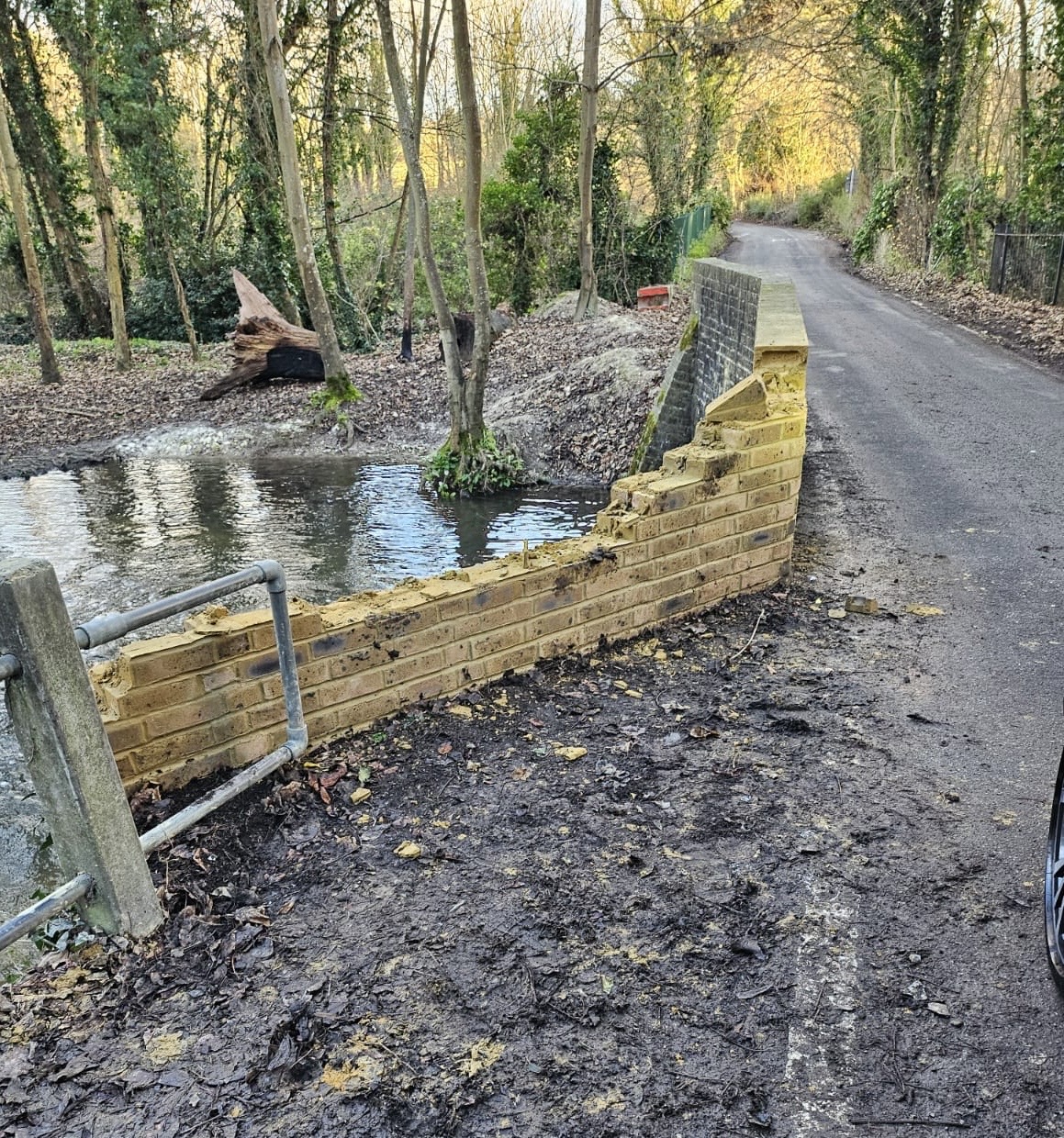
Franks Lane bridge works vandalised

Many Horton Kirby residents will have seen that the works on the Franks Lane bridge, running through the week commencing 16 December, have been vandalised. This took place on Thursday, and as the picture shows (photo credit: Councillor Alan White) the new brick work has been pushed into the river.

This is the most dismal and appalling vandalism, and comes when the works were heading to completion. I have been in contact with Kent Highways officers, and contractors were due to attend and assess the damage on Friday. I was told that they plan to return during the week beginning 6 January, provided that the materials needed for the works are available. I will update when I know more.


Thursday, 12 December 2024

Franks Lane: closure for bridge repairs next week

Repairs will take place to the Franks Lane bridge in Horton Kirby at the start of next week. 

KCC officers attended the bridge on 29 November to inspect the damage (a large part of the parapet wall knocked into the river, more damage to the remaining part) and make plans for repair. 

The road will be closed (9:30 to 3:30) for up to five days starting Monday 16 December. Officers are hoping to maintain pedestrian access when it is safe to do so during this period. While repairs are carried out, new signage warning of narrow bridge ahead will be installed directly on to the brickwork of the parapet.

Wednesday, 4 December 2024

Help for Pensioners Just Missing Out

Last week at Kent County Council we launched our Just Missing Out scheme to help pensioners affected by rising living costs and the withdrawal of the Winter Fuel allowance. This builds on our work over recent years supporting residents through our Financial Hardship Programme.

The Chancellor announced in the summer the withdrawal of Winter Fuel Payment from all older people except those in receipt of Pension Credit. In response, we have already got under way a campaign, along with many of our partners, to spread the word about Pension Credit and boost takeup. There are an estimated 18,000 households in Kent who are eligible for Pension Credit but not claiming it. Getting access to that can unlock a number of other entitlements, including Winter Fuel Payment. We continue to push this campaign, especially since the deadline for applying for and backdating this year’s Winter Fuel Payment is approaching (21 December). 

The problem is that this initiative, important as it is, cannot help the ‘Just Missing Out’ group of pensioners who are not on high incomes but are above the eligibility level for Pension Credit. We have therefore allocated for this group £1m out of the £11m that we were allocated in the latest round of the Household Support Find (a scheme set up under the previous government and continued by the new administration). Under this scheme, which went live on 28 November, we will be providing £200 vouchers which can be redeemed for food, energy or both. This will be available to households with annual incomes ranging from £11,383.80 (single households) or £17,713.40 (couples) to £40,000. 

The application link can be found on our website.

In recent years, KCC has provided extensive support to residents through our Financial Hardship Programme, which aims both at immediate help and building a lasting legacy of enhancing financial resilience. The programme has meant the distribution of 48,000 food and fuel vouchers to help with household bills, 5,000 laptops being supplied to people without access to technology, 150 children are now in their own beds, rather than sharing with siblings or sleeping on sofas, and more than 2,600 people are not dealing with their debt on their own. 

Our Cabinet meeting last week both launched this new scheme for pensioners and reviewed the achievements of the Financial Hardship Programme while planning for its future.

You can find our media release about the scheme, and our Cabinet meeting here.


Monday, 11 November 2024

Friendship with Chernihiv


I returned a week ago from a visit to the Chernihiv region of Ukraine. The starting point for this was the County Council’s decision in July to establish a programme of co-operation between Kent and Chernihiv. Following the Council resolution, I was invited by the Regional Administration in Chernihiv to visit to sign the Memorandum of Understanding (MoU) between the regions and to investigate a number of areas of cooperation.

I traveled with Jordan Meade, County Councillor for Gravesend East and Deputy Cabinet Member for Communities, who has worked closely with his local community to build links and supply humanitarian assistance to Ukraine, and in particular to Chernihiv. 

The County Council resolution was clear that KCC’s role in this is a coordinating one, and that as something that is not core County Council activity this cannot be a call on Council resources in any material way. In that spirit, Jordan and I traveled at our own expense. 

Chernihiv region is to the north-east of Kyiv, and borders both Russia and Belarus. (The city itself is about 60 miles from the Russian border and somewhat closer to the Belarusian border). In the early weeks of the war, the region was invaded and the city encircled, though Russian forces were then repelled. The region remains subject to attacks and air alerts. 

We spent an intensive three days with the Regional Administration, led by the Governor Vyacheslav Chaus. Our visit covered areas such as health (the city’s cardiology unit was bombed during the attacks), school and university education, cultural institutions, the business community and emergency services. We also visited the village of Yahidne, which was the site of horrific abuses when occupied by Russian soldiers, with many villagers held in cramped conditions in a school basement for weeks, as well as a children’s library that was devastated by a missile attack.

The County Council resolution identified a number of priority areas in which the Council could facilitate (but not deliver directly) links between the regions: humanitarian support; economic development and business; heritage, tourism, sport, health and the natural environment; education, skills and language. Through our visit, we established connections to take these areas forward.

And some overall impressions? It was, as I reported to Council last week, an intense and unforgettable experience. One striking feature was the apparent normality of much day to day life - and what it takes to sustain this under war conditions (schools can deliver in person learning, but have bomb shelters to sustain that; people learn to live with an assess the risks of an attack). That normality, and some hope for the future are vital to sustaining the morale of a population that has now had to live with two and a half years of devastating war. Anything our co-operation agreement can do to help that seems to me to be very worthwhile.

You can find a KCC media release on the visit here.

Saturday, 9 November 2024

Swanley Village Road: cleansing the culvert

I wrote in the recent Swanley Village newsletter than the long-awaited works on the culvert in Swanley Village Road were due to take place on Wednesday (6 November).

When it appeared that this had not been completed, I followed up with KCC officers. It appears that the screen was cleared, and the gullies cleansed and jetted. However, the contractors did not jet the culvert itself, apparently because they did not have what they believed to be the correct vehicle to carry out the work safely. KCC required that they return with the appropriate vehicle, and it appears that there was a revisit yesterday and the works were completed.

Wednesday, 16 October 2024

The Space Wagon Takes Off


Congratulations to The Space at the Riverside Club for a wonderful launch of its Community Transport service this morning. This comprises a growing network of volunteer drivers, using their own cars, but also a bookable wheelchair accessible vehicle: the Space Wagon, the inspired winner of a competition to name it.

This builds on the remarkable work of Adrian Elms, Steve Boddington and everyone at The Space in combating isolation. Access to transport plays a vital role in this, yet in Kent (and across the country, especially outside the big cities) the bus industry is under severe pressure. This is why at Kent County Council we have stepped up our support for Community Transport. Last year we allocated over £500,000 to a dozen such schemes across the County. The Space was one of these, being awarded £44,000 in capital and £3,000 in start up costs. I was delighted to be able to support the successful bid.

Steve and Adrian both spoke at this morning’s launch, along with Cllr Lawrence Ball (Chairman of Sevenoaks District Council), Sally Coston of Eynsford Village Society and me. And the ribbon was cut by Mrs Diana Grant.

I was struck this morning by Steve Boddington’s remark that the focus on transport came out of the work that The Space was already doing, picking up another important need. I was also reminded that, while public sector bodies (including KCC) are financially very constrained, grants that are quite small in relation to our total budgets can help community initiatives like The Space Wagon to thrive.

To begin with at least, The Space’s community transport initiative will focus on Eynsford, Farningham and Lullingstone but will hopefully be able to extend to a wider area, the more so given the importance of access to medical appointments and the coming together of the Farningham and South Darenth practices.